

The Mission Challenge
Modern military, government, and mission-critical operations depend on the continuous movement of increasingly large volumes of data across complex and distributed networks. Ships at sea, tactical operators at the edge, airborne platforms, command centers, cloud environments, sensors, AI systems, and geographically dispersed teams must exchange critical information quickly and reliably to maintain situational awareness and support informed decision-making.
Yet the environments in which these missions operate are often the least suited to conventional data transfer.
Limited bandwidth, intermittent connectivity, high latency, network congestion, disruption, interference, and complete disconnection can prevent mission-critical data from reaching the people and systems that need it most. A communications link may be available one moment and unavailable the next. A large transfer can progress for hours, only to be interrupted before completion. When conventional transfer technologies restart that process from the beginning, valuable bandwidth, time, and operational momentum are lost.
The challenge becomes even more significant as data volumes continue to grow. High-resolution imagery, intelligence products, sensor data, software updates, mission files, logistics information, AI models, vector databases, and other data-intensive workloads increasingly need to move between the enterprise, cloud, command centers, ships, remote locations, and the tactical edge.
The network is no longer simply carrying messages. It is being asked to move the operational knowledge required to execute the mission.
Traditional data-transfer approaches are generally optimized for stable, persistent connectivity. But contested and distributed operations cannot assume that the network will always be available, that bandwidth will always be sufficient, or that a transfer will remain uninterrupted from beginning to end.
This creates a fundamental operational challenge:
How do you reliably move critical data when bandwidth is constrained, connectivity is intermittent, networks are disrupted, and failure is not an acceptable outcome?
The answer is not simply to wait for a better network or continually retransmit the same data. Mission systems need a fundamentally more resilient approach to data mobility—one that minimizes the amount of information that must cross the network, preserves progress when communications are interrupted, automatically continues when connectivity returns, and ensures critical data ultimately reaches its intended destination.
That is the challenge SmartSync DCS 2.0 was built to solve
The SmartSync® DCS 2.0 Platform
Move Less Data. Survive Disruption. Deliver with Confidence
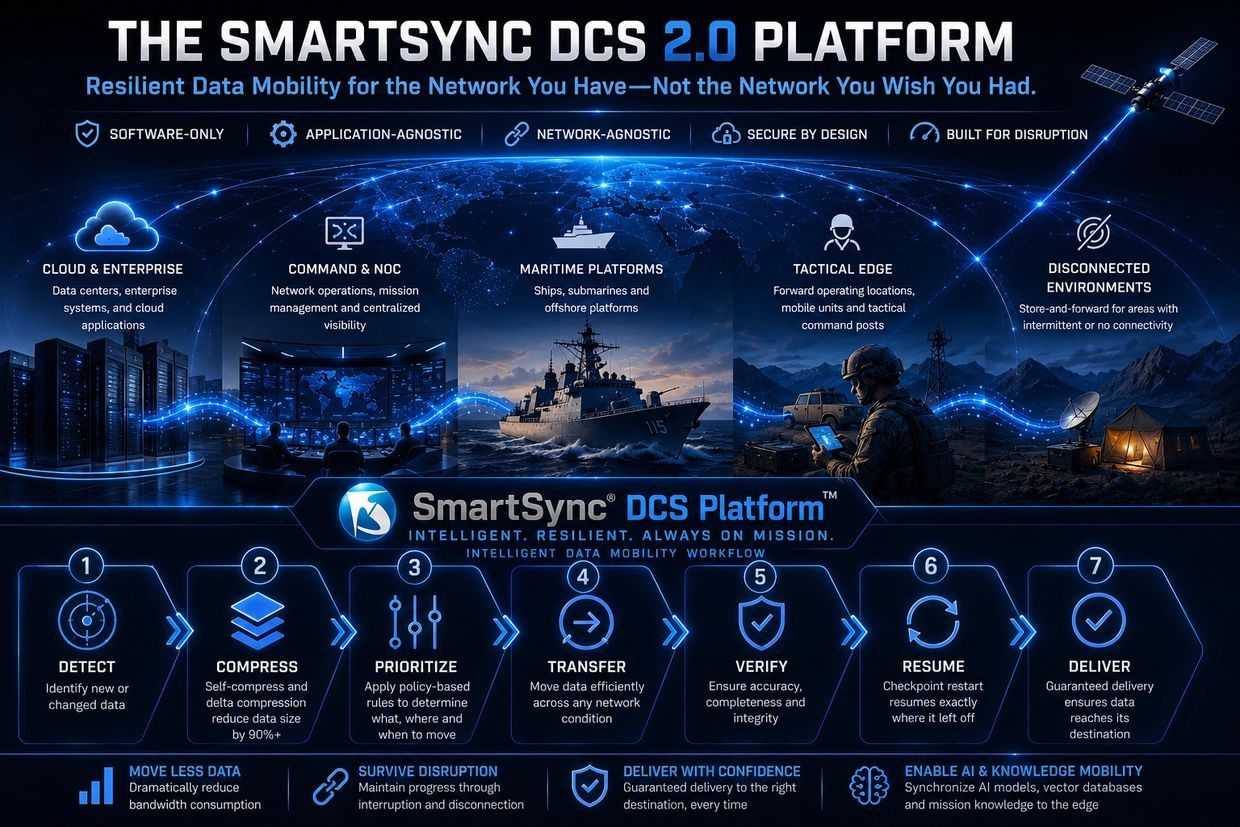
SmartSync DCS 2.0 is a resilient data mobility and synchronization platform engineered to move mission-critical data reliably across constrained, intermittent, disrupted, and disconnected environments. It provides an intelligent software layer between applications, systems, networks, and operational endpoints—helping ensure that critical information continues moving even when the underlying communications infrastructure is unreliable.
Unlike conventional data-transfer technologies that depend on persistent, stable connectivity, SmartSync is designed around a different operational reality: networks fail, bandwidth fluctuates, connections disappear, and transfers are interrupted. Rather than treating these conditions as exceptions, SmartSync treats them as fundamental characteristics of the operating environment.
One Platform. Across the Enterprise, Cloud and Tactical Edge
SmartSync provides a common data-mobility framework across diverse operational environments—from cloud infrastructure and enterprise data centers to network operations centers, maritime platforms, forward-deployed forces, tactical edge nodes, and locations operating with intermittent or no connectivity.
The platform is software-only, application-agnostic, and network-agnostic, allowing it to complement existing systems and infrastructure without requiring a wholesale replacement of applications, networks, or communications technologies. SmartSync is designed to operate as an intelligent data-mobility layer, improving how information moves across the infrastructure already in place.
Whether moving mission files from shore to ship, synchronizing data between enterprise and edge environments, delivering software updates to remote locations, or transporting AI models and operational knowledge to disconnected users, SmartSync applies the same underlying principle:
Move only the data that needs to move, preserve progress through disruption, and ensure critical information ultimately reaches its intended destination.
Intelligent Data Movement from Source to Destination
SmartSync continuously identifies new or changed data and applies advanced compression techniques to dramatically reduce the volume of information that must traverse the network. Policy-based rules can determine what data moves, where it moves, when it moves, and under what conditions, allowing available communications resources to be aligned with operational priorities.
As data moves across the network, SmartSync verifies transfer completeness and integrity. If connectivity is interrupted, checkpoint restart preserves transfer progress rather than forcing the transmission to begin again from the start. When communications return, the transfer can resume from where it left off.
This capability is especially important for large datasets and constrained communications links, where retransmitting an entire file after every interruption can consume valuable bandwidth, extend delivery times, and prevent critical information from reaching the edge when it is needed.
Built for Disruption
The fundamental distinction of SmartSync is not simply that it transfers data efficiently. It is engineered to maintain data movement through conditions that cause conventional transfer methods to fail or become operationally inefficient.
In a stable network environment, many technologies can move data. The greater challenge is maintaining reliable data mobility when bandwidth is limited, latency is high, connectivity is intermittent, and endpoints may remain disconnected for extended periods.
SmartSync addresses this challenge through a combination of compression, checkpoint restart, store-and-forward, guaranteed delivery, and policy-based replication. Together, these capabilities help preserve data, maintain transfer progress, minimize unnecessary retransmission, and automatically continue operations as network conditions change.
From Data Mobility to AI Knowledge Mobility
As defense and mission systems increasingly incorporate artificial intelligence, the challenge is expanding beyond moving traditional files and datasets. Operational organizations must also move AI models, vector databases, embeddings, mission datasets, software updates, and continually evolving knowledge between cloud, enterprise, command, and tactical-edge environments.
SmartSync extends resilient data mobility to these emerging AI workloads, helping move critical knowledge closer to the point of decision—even when connectivity is constrained or intermittent.
This creates a critical bridge between powerful enterprise and cloud-based AI capabilities and the operators, platforms, and systems that need updated information at the tactical edge.
Designed to Work with the Network You Have
SmartSync does not require perfect connectivity to provide value. It is specifically designed for environments where connectivity cannot be guaranteed.
By reducing the amount of data that must move, preserving progress when communications are interrupted, automatically resuming transfers when connectivity returns, and ensuring critical information reaches its intended destination, SmartSync helps transform constrained and unreliable communications networks into more effective pathways for mission-critical data.
The objective is straightforward: move less data, survive disruption, deliver with confidence, and extend mission knowledge to the edge.

One Integrated Platform
SmartSync Capabilities
SmartSync DCS 2.0 combines advanced data reduction, resilient transfer, intelligent replication, and automated recovery capabilities to keep mission-critical data moving across constrained, intermittent, disrupted, and disconnected networks.
- Self-Compression & Delta Compression — Dramatically reduce data volumes by compressing information before transmission and moving only what has changed. Demonstrated reductions of 90%+ in applicable operational environments.
- Checkpoint Restart & Guaranteed Delivery — Preserve transfer progress through interruptions and automatically resume from the point of disruption, helping ensure mission-critical data ultimately reaches its intended destination.
- Store-and-Forward — Safely preserve data when endpoints are unavailable and automatically continue delivery when connectivity returns.
- Policy-Based Replication — Control what data moves, where it moves, when it moves, and under what conditions, aligning data movement with mission priorities.
- Bandwidth Optimization — Combine compression, delta technology, and resilient transfer methods to maximize the operational value of constrained communications links.
- AI Knowledge Mobility — Synchronize AI models, vector databases, mission datasets, and evolving operational knowledge between cloud, enterprise, and tactical-edge environments.
Move less data. Survive disruption. Deliver with confidence. Extend mission knowledge to the edge